Sir Alexander Richard Glen KBE DSC (1912 – 2004)
Arctic explorer who served with Tito’s partisans and later went into the travel business
The Telegraph 09 March 2004
Sir Alexander Glen, who has died aged 91, was an Arctic explorer and wartime Intelligence officer before going into the shipping industry and eventually becoming chairman of the British Tourist Authority.
Glen had an unusual introduction to the Arctic in 1932. He thought he had accepted a friend’s invitation to a debutante dance, then found that it was to go to Spitsbergen as one of the eight-man crew of a 45ft Peterhead fishing boat owned by a Cambridge law don. The expedition committed him to 4,000 miles of sailing and two months of surveying in the mountains; it left him fascinated by the Arctic.
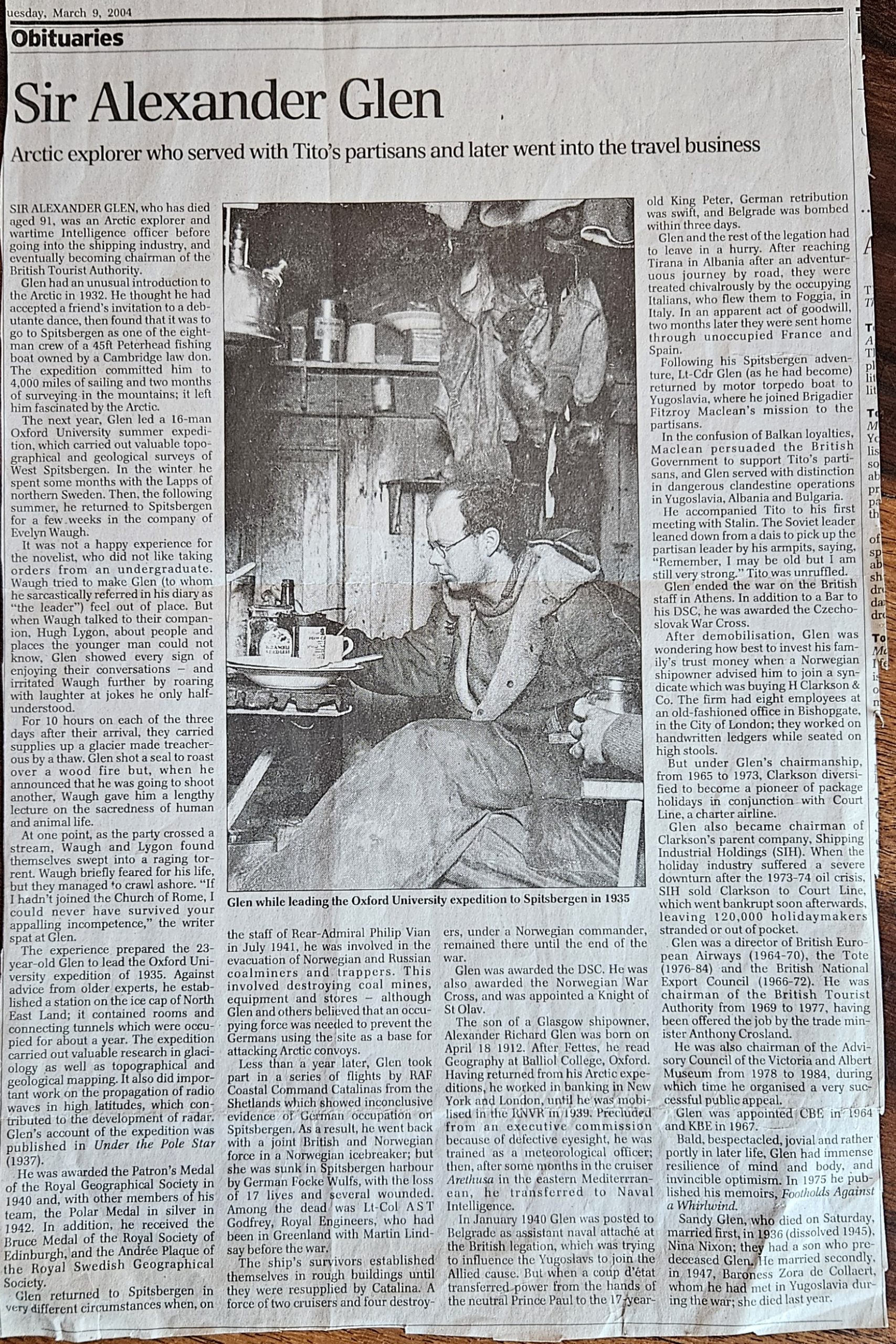
The next year, Glen led a 16-man Oxford University summer expedition, which carried out valuable topographical and geological surveys of West Spitsbergen. In the winter he spent some months with the Lapps of northern Sweden. Then, the following summer, he returned to Spitsbergen for a few weeks in the company of Evelyn Waugh.
It was not a happy experience for the novelist, who did not like taking orders from an undergraduate. Waugh tried to make Glen (to whom he sarcastically referred in his diary as “the leader”) feel out of place. But when Waugh talked to their companion, Hugh Lygon, about people and places the younger man could not know, Glen showed every sign of enjoying their conversations – and irritated Waugh further by roaring with laughter at jokes he only half-understood.
For 10 hours on each of the three days after their arrival, they carried supplies up a glacier made treacherous by a thaw. Glen shot a seal to roast over a wood fire but, when he announced that he was going to shoot another, Waugh gave him a lengthy lecture on the sacredness of human and animal life.
At one point, as the party crossed a stream, Waugh and Lygon found themselves swept into a raging torrent. Waugh briefly feared for his life, but they managed to crawl ashore. “If I hadn’t joined the Church of Rome, I could never have survived your appalling incompetence,” the writer spat at Glen.
The experience prepared the 23-year-old Glen to lead the Oxford University expedition of 1935. Against advice from older experts, he established a station on the ice cap of North East Land; it contained rooms and connecting tunnels which were occupied for about a year. The expedition carried out valuable research in glaciology as well as topographical and geological mapping. It also did important work on the propagation of radio waves in high latitudes, which contributed to the development of radar. Glen’s account of the expedition was published in Under the Pole Star (1937).
He was awarded the Patron’s Medal of the Royal Geographical Society in 1940 and, with other members of his team, the Polar Medal in silver in 1942. In addition, he received the Bruce Medal of the Royal Society of Edinburgh, and the Andree Plaque of the Royal Swedish Geographical Society.
Glen returned to Spitsbergen in very different circumstances when, on the staff of Rear-Admiral Philip Vian in July 1941, he was involved in the evacuation of Norwegian and Russian coalminers and trappers. This involved destroying coal mines, equipment and stores – although Glen and others believed that an occupying force was needed to prevent the Germans using the site as a base for attacking Arctic convoys.
Less than a year later, Glen took part in a series of flights by RAF Coastal Command Catalinas from the Shetlands which showed inconclusive evidence of German occupation on Spitsbergen. As a result, he went back with a joint British and Norwegian force in a Norwegian icebreaker; but she was sunk in Spitsbergen harbour by German Focke Wulfs, with the loss of 17 lives and several wounded. Among the dead was Lt-Col A S T Godfrey, Royal Engineers, who had been in Greenland with Martin Lindsay before the war.
The ship’s survivors established themselves in rough buildings until they were resupplied by Catalina. A force of two cruisers and four destroyers, under a Norwegian commander, remained there until the end of the war.
Glen was awarded the DSC. He was also awarded the Norwegian War Cross and was appointed a Knight of St Olav.
The son of a Glasgow shipowner, Alexander Richard Glen was born on April 18, 1912. After Fettes, he read Geography at Balliol College, Oxford. Having returned from his Arctic expeditions, he worked in banking in New York and London, until he was mobilised in the RNVR in 1939. Precluded from an executive commission because of defective eyesight, he was trained as a meteorological officer; then, after some months in the cruiser Arethusa in the eastern Mediterrranean, he transferred to Naval Intelligence.
In January 1940 Glen was posted to Belgrade as assistant naval attaché at the British legation, which was trying to influence the Yugoslavs to join the Allied cause. But when a coup d’etat transferred power from the hands of the neutral Prince Paul to the 17-year-old King Peter, German retribution was swift, and Belgrade was bombed within three days.
Glen and the rest of the legation had to leave in a hurry. After reaching Tirana in Albania after an adventurous journey by road, they were treated chivalrously by the occupying Italians, who flew them to Foggia, in Italy. In an apparent act of goodwill, two months later they were sent home through unoccupied France and Spain.
Following his Spitsbergen adventure, Lt-Cdr Glen (as he had become) returned by motor torpedo boat to Yugoslavia, where he joined Brigadier Fitzroy Maclean’s mission to the partisans.
In the confusion of Balkan loyalties, Maclean persuaded the British Government to support Tito’s partisans, and Glen served with distinction in dangerous clandestine operations in Yugoslavia, Albania and Bulgaria.
He accompanied Tito to his first meeting with Stalin. The Soviet leader leaned down from a dais to pick up the partisan leader by his armpits, saying, “Remember, I may be old, but I am still very strong.” Tito was unruffled.
Glen ended the war on the British staff in Athens. In addition to a Bar to his DSC, he was awarded the Czechoslovak War Cross.
After demobilisation, Glen was wondering how best to invest his family’s trust money when a Norwegian shipowner advised him to join a syndicate which was buying H Clarkson & Co. The firm had eight employees at an old-fashioned office in Bishopsgate, in the City of London; they worked on handwritten ledgers while seated on high stools.
But under Glen’s chairmanship, from 1965 to 1973, Clarkson diversified to become a pioneer of package holidays in conjunction with Court Line, a charter airline.
Glen also became chairman of Clarkson’s parent company, Shipping Industrial Holdings (SIH). When the holiday industry suffered a severe downturn after the 1973-74 oil crisis, SIH sold Clarkson to Court Line, which went bankrupt soon afterwards, leaving 120,000 holidaymakers stranded or out of pocket.
Glen was a director of British European Airways (1964-70), the Tote (1976-84) and the British National Export Council (1966-72). He was chairman of the British Tourist Authority from 1969 to 1977, having been offered the job by the trade minister Anthony Crosland.
He was also chairman of the Advisory Council of the Victoria and Albert Museum from 1978 to 1984, during which time he organised a very successful public appeal.
Glen was appointed CBE in 1964 and KBE in 1967.
Bald, bespectacled, jovial and rather portly in later life, Glen had immense resilience of mind and body, and invincible optimism. In 1975 he published his memoirs, Footholds Against a Whirlwind.
Sandy Glen, who died on Saturday, married first, in 1936 (dissolved 1945), Nina Nixon; they had a son who predeceased Glen. He married secondly, in 1947, Baroness Zora de Collaert, whom he had met in Yugoslavia during the war; she died last year.
Adventurer whose undergraduate exploration of the Arctic was put to good use in the wartime seizure of Spitzbergen from Germany
The Times 09 March 2004
Sandy Glen was a man of action who was both articulate and contemplative. His life had three main threads the Arctic the Balkans and the City, all linked by lifelong friendships. Katie bell at his love of adventure on Oxford university’s Arctic expeditions in the 1930s.
In 1934 Evelyn Waugh accompanied him to Spitzbergen. Waugh was not so enamoured of cold discomfort. On one occasion pressed close to Glen on a narrow ledge sheltering in a storm Waugh spat: “This is typical of your folly. If I hadn’t joined the Church of Rome, I could never have survived your appalling incompetence.”
Alexander Glen was born in 1912 in Glasgow, the son of a shipowner educated at Fettes school, Glen was by his own account idle until his last year. he later said that the misty Edinburgh playing fields made the Arctic seem like the Ritz. After a year in France, he went up to Balliol College Oxford, in 1931 to read geography.
Glen led the Oxford University expedition (supported by the Royal Society and the Royal Geographical Society) to North East Land, an icy island adjacent to Spitzbergen, in 1935-36. It was, among other things, to be a testing ground for information-gathering for wartime bases, radio stations and flying routes.
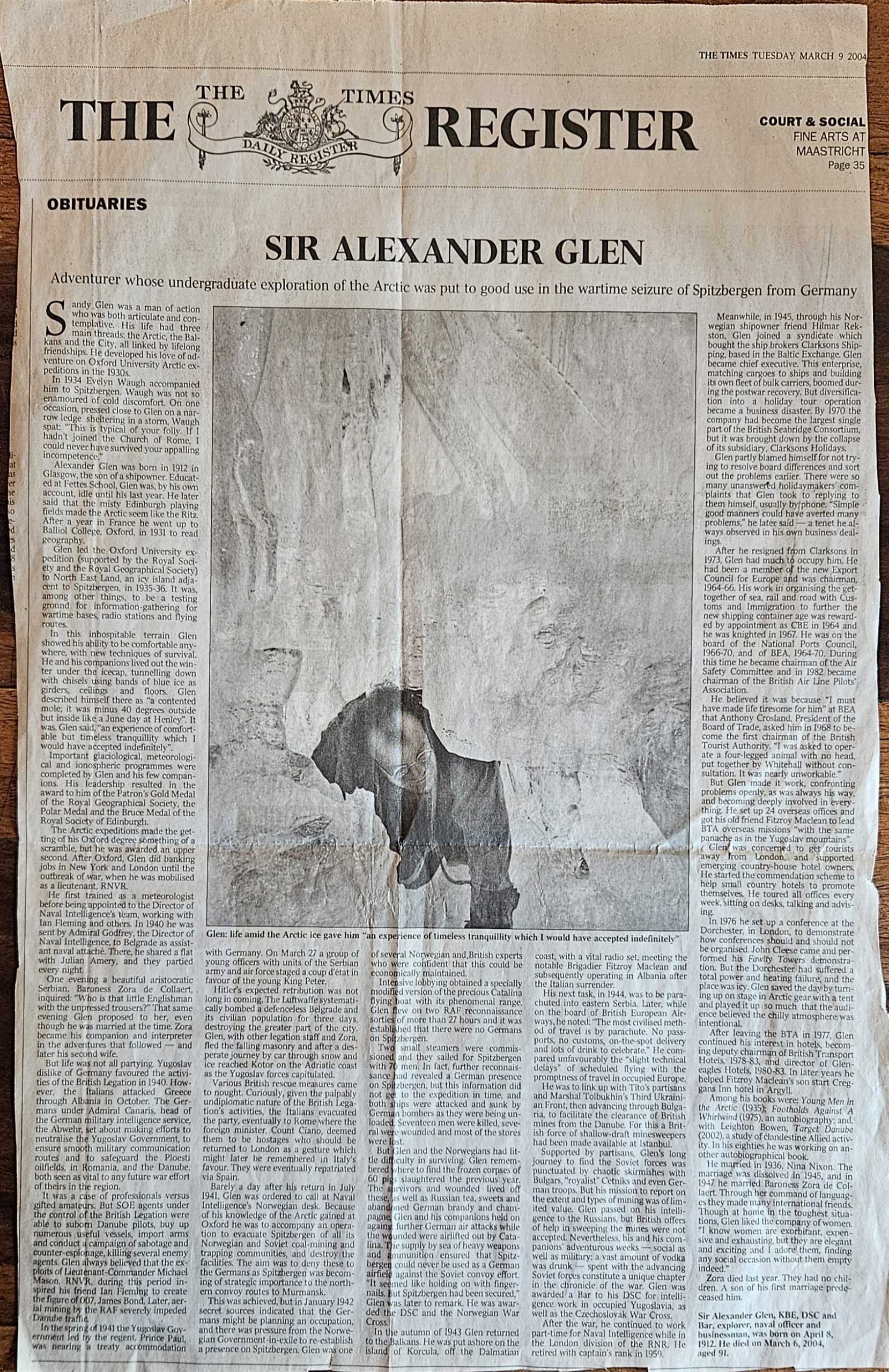
In the inhospitable terrain Glen showed his ability to be comfortable anywhere, with new techniques of survival. He and his companions lived out the winter under the icecap, tunnelling down with chisels using bands of blue ice as girders, ceilings and floors. Glen described himself there as “a contented mole; it was minus 40 degrees outside but inside like a June day at Henley”. It was, Glen said, “an experience of comfortable but timeless tranquillity which I would have accepted indefinitely”.
Important glaciological, meteorological and ionospheric programmes were completed by Glen and a few of his companions. His leadership resulted in an award to him of the patron’s Gold Medal of the Royal Geographical Society, the Polar Medal and the Bruce Medal of the Royal Society of Edinburgh.
The arctic expeditions made their getting’s of his Oxford degree something of a scramble, but he was awarded an upper second. After Oxford Glen did banking jobs in New York and London until the outbreak of war when he was mobilised as a Lieutenant, RNVR.
He first trained as a meteorologist before being appointed to the director of naval intelligence team, working with Ian Fleming and others. In 1940 he was sent by Admiral Godfrey, the director of naval intelligence to Belgrade as assistant naval attaché. There he shared a flat with Julian Amery, and they partied every night.
One evening a beautiful aristocratic Serbian, Baroness Zora de Collaert, inquired: “Who is that little Englishman with the unimpressed trousers?” That same evening Glenn proposed to her even though he was married at the time. Zora became his companion and in the adventures that followed – and later his second wife.
But life was not all partying. Yugoslav dislike of Germany favoured the activities of the British Legation in 1940. However, the Italians attacked Greece through Albania in October. The Germans under Admiral Canaris, head of the German military intelligence service, the Abwehr, set about making efforts to neutralise the Yugoslav Government, to ensure smooth military communication routes and to safeguard the Ploesti oilfields, in Romania, and the Danube, both seen as vital to any future war effort of theirs in the region.
It was a case of professionals versus gifted amateurs. But SOE agents under the control of the British Legation were able to suborn Danube pilots, buy up numerous useful vessels, import arms and conduct a campaign of sabotage and counterespionage, killing several enemy agents. Glen always believed that exploits of Lieutenant-Commander Michael Mason, RNVR, during this period in-spired his friend Ian Fleming to create the figure of 007, James Bond, Later, aerial mining by the RAF severely impeded Danube traffic.
In the spring of 1941, the Yugoslav Government led hy the regent, Prince Paul, was nearing a treaty accommodation with Germany. On March 27 a group of young officers with units of the Serbian army and air force staged a coup d’etat in favour of the young King Peter.
Hitler’s expected retribution was not long in coming. The Luftwaffe systematically bombed a defenceless Belgrade and its civilian population for three days, destroying the greater part of the city.
Glen, with other legation staff and Zora, fled the falling masonry and after a desperate journey by car through snow and ice reached Kotor on the Adriatic coast as the Yugoslav forces capitulated.
Various British rescue measures came to nought. Curiously, given the palpably undiplomatic nature of the British Legation’s activities, the Italians evacuated the party, eventually to Rome where the foreign minister, Count Ciano, deemed them to be hostages who should be returned to London as a gesture which might later be remembered in Italy’s favour. They were eventually repatriated via Spain.
Barely a day after his return in July 1941, Glen was ordered to call at Naval Intelligence’s Norwegian desk. Because of his knowledge of the Arctic gained at Oxford he was to accompany an operation to evacuate Spitzbergen of all its Norwegian and Soviet coalmining and trapping communities and destroy the facilities. The aim was to deny these to the Germans as Spitzbergen was becoming of strategic importance to the northern convoy routes to Murmansk.
This was achieved, but in January 1942 secret sources indicated that the Germans might be planning an occupation and there was pressure from the Norwegian Government-in-exile to re-establish a presence on Spitzbergen. Glen was one of several Norwegian and British experts who were confident that this could be economically maintained.
Intensive lobbying obtained a specially modified version of the precious Catalina flying boat with its phenomenal range. Glen flew on two RAF reconnaissance sorties of more than 27 hours and it was established that there were no Germans on Spitzbergen.
Two small steamers were commissioned, and they sailed for Spitzbergen with 70 men. In fact, further reconnaissance had revealed a German presence on Spitzbergen, but this information did not get to the expedition in time, and both ships were attacked and sunk by German bombers as they were being unloaded. Seventeen men were killed, several were wounded and most of the stores were lost.
But Glen and the Norwegians had little difficulty in surviving. Glen remembered where to find the frozen corpses of 60 pigs slaughtered the previous year.
The survivors and wounded lived off these, as well as Russian tea, sweets and abandoned German brandy and champagne. Glen and his companions held on against further German air attacks while the wounded were airlifted out by Catalina. The supply by sea of heavy weapons and ammunition ensured that Spitzbergen could never be used as a German airfield against the Soviet convoy effort. “It seemed like holding on with fingernails. But Spitzbergen had been secured,” Glen was later to remark. He was awarded the DSC and the Norwegian War Cross.
In the autumn of 1943 Glen returned to the Balkans. He was put ashore on the island of Korcula, off the Dalmatian coast, with a vital radio set, meeting the notable Brigadier Fitzroy Maclean and subsequently operating in Albania after the Italian surrender.
His next task, in 1944, was to be parachuted into eastern Serbia. Later, while on the board of British European Airways, he noted: “The most civilised method of travel is by parachute. No passports, no customs, on-the-spot delivery and lots of drink to celebrate.” He compared unfavourably the “slight technical delays” of scheduled flying with the promptness of travel in occupied Europe.
He was to link up with Tito’s partisan and Marshal Tolbukhin’s Third Ukrainian Front, then advancing through Bulgari, to facilitate the clearance of British mines from the Danube. For this a British force of shallow-draft minesweepers had been made available at Istanbul.
Supported by partisans, Glen’s long journey to find the Soviet forces was punctuated by chaotic skirmishes with Bulgars, “royalist” Cetniks and even German troops. But his mission to report on the extent and types of mining was of limited value. Glen passed on his intelligence to the Russians, but British offers of help in sweeping the mines were not accepted. Nevertheless, his and his companions’ adventurous weeks -social as well as military: a vast amount of vodka was drunk – spent with the advancing Soviet forces constitute a unique chapter in the chronicle of the war. Glen was awarded a Bar to his DSC for intelligence work in occupied Yugoslavia, as well as the Czechoslovak War Cross.
After the war, he continued to work part-time for Naval Intelligence while in the London division of the RNR. He retired with captain’s rank in 1959.
Meanwhile, in 1945, through his Norwegian shipowner friend Hilmar Rekston, Glen joined a syndicate which bought the ship brokers Clarksons Shipping, based in the Baltic Exchange. Glen became chief executive. This enterprise, matching cargoes to ships and building its own fleet of bulk carriers, boomed during the postwar recovery. But diversification into a holiday tour operation became a business disaster. By 1970 the company had become the largest single part of the British Seabridge Consortium, but it was brought down by the collapse of its subsidiary, Clarkson’s Holidays.
Glen partly blamed himself for not trying to resolve board differences and sort out the problems earlier. There were so many unanswered holidaymakers’ complaints that Glen took to replying to them himself, usually by phone. “Simple good manners could have averted many problems,” he later said – a tenet he always observed in his own business dealings.
After he resigned from Clarkson’s in 1973, Glen had much to occupy him. He had been a member of the new Export Council for Europe and was chairman, 1964-66. His work in organising the get-together of sea, rail and road with Customs and Immigration to further the new shipping container age was rewarded by appointment as CBE in 1964 and he was knighted in 1967. He was on the board of the National Ports Council, 1966-70, and of BEA, 1964-70. During this time, he became chairman of the British Air Line Pilots’ Association.
He believed it was because “I must have made life tiresome for him” at BEA that Anthony Crosland, President of the Board of Trade, asked him in 1968 to become the first chairman of the British Tourist Authority. “I was asked to operate a four-legged animal with no head, put together by Whitehall without consultation. It was nearly unworkable”.
But Glen made it work, confronting problems openly, as was always his way, and becoming deeply involved in everything. He set up 24 overseas offices and got his old friend Fitzroy Maclean to lead BTA overseas missions “with the same panache as in the Yugoslav mountains”.
Glen was concerned to get tourists away from London and supported emerging country-house hotel owners. He started the commendation scheme to help small country hotels to promote themselves. He toured all offices every week, sitting on desks, talking and advising.
IN 1976 he set up a conference at the Dorchester, in London to demonstrate how conferences should and should not be organised. John Cleese came and performed his Fawlty Towers demonstration. But the Dorchester had suffered a total power and heating failure, and the place was icy. Glen saved the day by turning up on stage in Arctic gear with a tent and played it up so much that the audience believed the chilly atmosphere was intentional
After leaving the BTA in 1977, Glen continued his interest in hotels, becoming deputy chairman of British Transport Hotels, 1978-83, and director of Gleneagles Hotels, 1980-83. In later years he helped Fitzroy Maclean’s son start Creggan Inn hotel in Argyll.
Among his books were: Young Men in the Arctic (1935); Footholds Against A Whirlwind (1975), an autobiography; and, with Leighton Bowen, Target Danube (2002), a study of clandestine Allied activity. In his eighties he was working on another autobiographical book.
He married in 1936, Nina Nixon. The marriage was dissolved in 1945, and in 1947 he married Baroness Zora de Collaert. Through her command of languages, they made many international friends. Though at home in the toughest situations, Glen liked the company of women.
“I know women are exorbitant, expensive and exhausting, but they are elegant and exciting and I adore them, finding any social occasion without them empty indeed.”
Zora died last year. They had no children. A son of his first marriage predeceased him.
Sir Alexander Glen, KBE, DSC and Bar, explorer, naval officer and businessman, was born on April 8, 1912. He died on March 6, 2004, aged 91.